
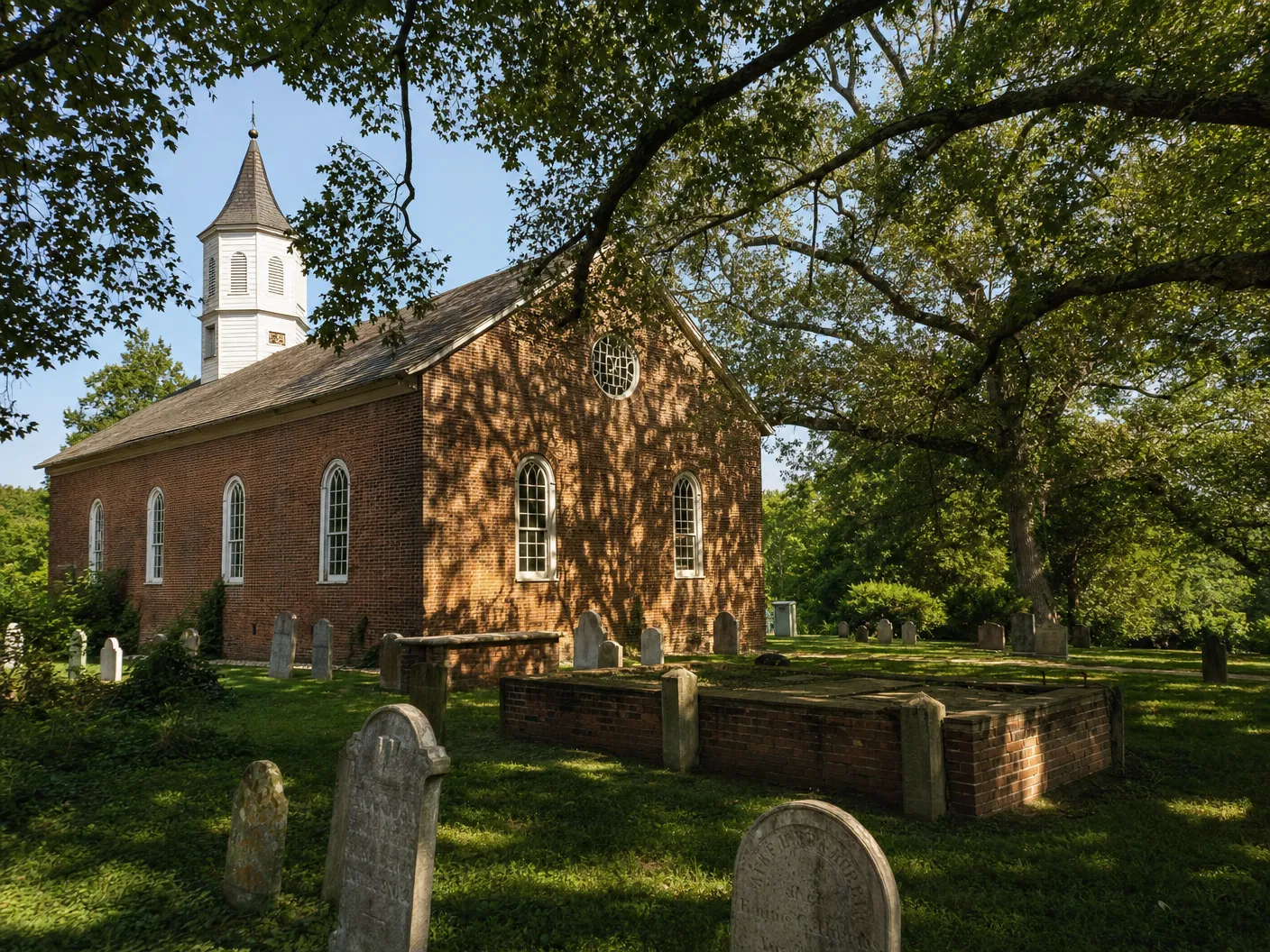
A mission built for community
St. Simon’s Mission began in Croom in 1896, according to St. Thomas’ Parish history, as an African American parochial mission organized through the Willes family during the rectorate of the Rev. Francis P. Willes. Sunday school classrooms were moved across the road from St. Thomas’ Church, and a chapel was established on land purchased by Susan Willes. The mission became independent in 1902 under the Diocese of Washington.
The mission was more than a worship space. St. Thomas’ account describes separate educational and social events there, while the National Register record connects St. Simon’s with the Croom Industrial and Agricultural School, which offered practical education to African American children. The mission’s cemetery, consecrated in 1914, remains one of the clearest physical reminders of that community’s presence and care for its own.
A Croom connection to Pauli Murray
One of St. Simon’s vicars was the Rev. John Ethophilus Gratin Small, who served from 1921 to 1931 and was Pauli Murray’s uncle. St. Thomas’ Parish describes Murray as spending formative childhood years at St. Simon’s, in the community shaped by her uncle’s ministry. That local connection belongs alongside the wider story of Murray’s life: Harvard’s Schlesinger Library identifies her as an Episcopal priest, attorney, and civil-rights activist.
Murray’s later national importance does not make Croom a footnote. It helps us see how a rural African American faith community could be part of a child’s early world—and how places of worship, education, family, and public responsibility could overlap.
Remembering a place, not just a name
St. Simon’s congregation joined St. Thomas’ in 1964, and the mission buildings were demolished in the early 1970s. The cemetery remains a physical reminder documented in the National Register nomination. For present-day neighbors, its legacy is not only architectural; it is the record of people who made room for worship, learning, fellowship, and future possibility.
About these sources
This post cross-checks St. Thomas’ Parish’s local history with the Maryland Historical Trust/National Park Service National Register nomination for the St. Thomas’ Episcopal Parish Historic District, plus Harvard’s Schlesinger Library biography of Pauli Murray. The parish history dates the mission’s establishment to 1896; the National Register narrative describes construction of the mission chapel in 1894, so the wording distinguishes the mission’s documented 1896 beginning from the earlier chapel-construction date.
Sources & further reading
- 01St. Thomas’ Parish — History of St. Thomas’ Parish
- 02St. Thomas’ Parish — St. Simon’s Mission
- 03Maryland Historical Trust / National Park Service — St. Thomas’ Episcopal Parish Historic District National Register nomination
- 04Harvard Radcliffe Institute, Schlesinger Library — Pauli Murray collection biography